व्यापार समाचार समाचार

Sensex Tumbles 926.92 Points to 74,346.53 in Early Trade

व्यापार समाचार | Sensex Tumbles 926.92 Points to 74,346.53 in Early Trade

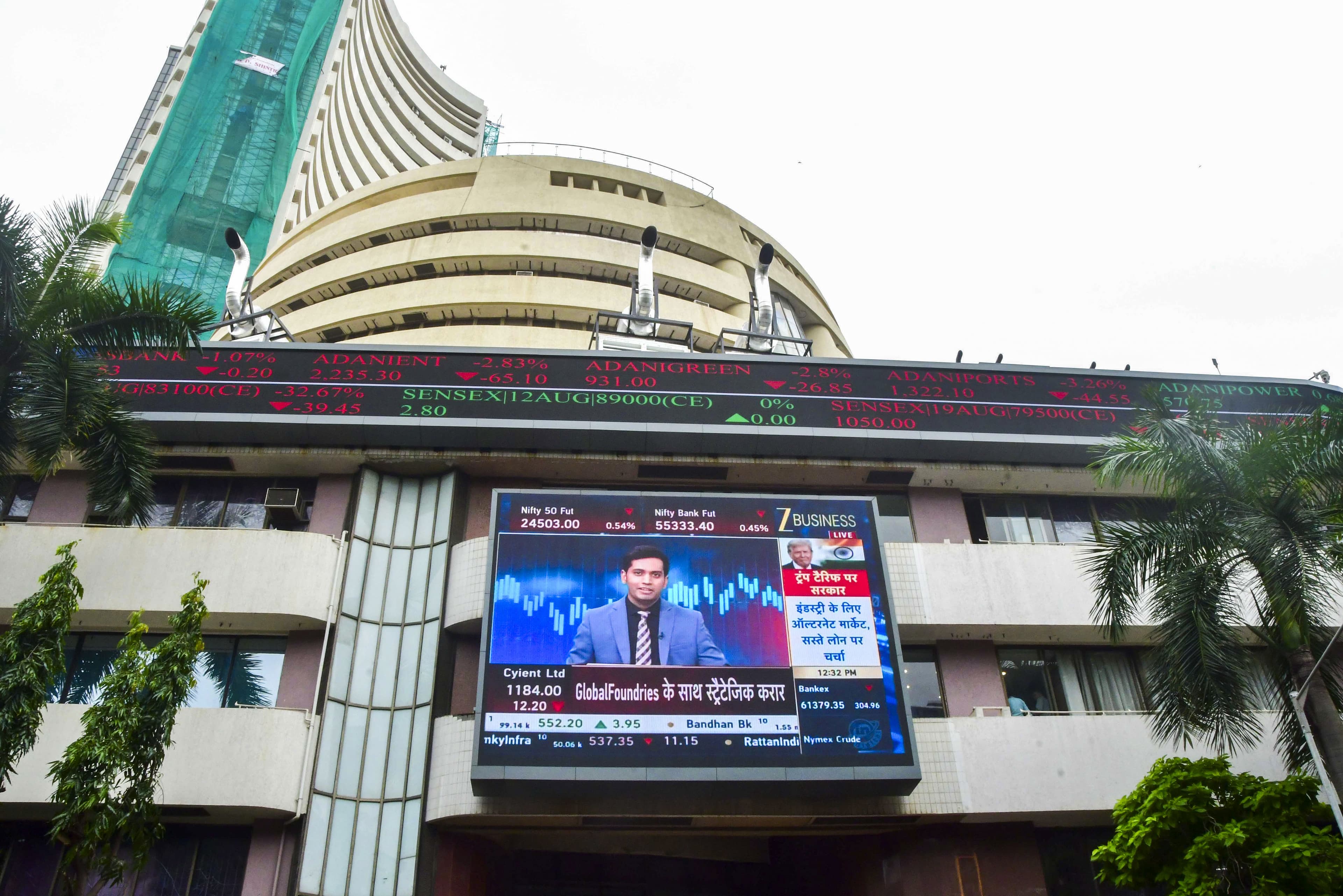
Mumbai: Benchmark indices Sensex and Nifty tumbled in early trade on Friday after a two-day rally, tracking a weak trend in global peers, as the US-Iran conflict continues to be a key overhang for the markets.Crude oil prices staying above the USD 100 per barrel mark and unabated foreign fund outflows have also made investors risk-averse. The 30-share BSE Sensex tanked 926.92 points to 74,346.53 in early trade. The 50-share NSE Nifty dropped 280.95 points to 23,025.50. From the 30-Sensex firms, Bajaj Finance, Larsen & Toubro, Reliance Industries, Eternal, InterGlobe Aviation, and Bajaj Finserv were among the major laggards. Tata Consultancy Services, HCL Tech, Tech Mahindra, and Trent were among the gainers. In Asian markets, South Korea's benchmark Kospi and Japan's Nikkei 225 index quoted lower, while Shanghai's SSE Composite index, and Hong Kong's Hang Seng index traded in positive territory. The US market ended sharply lower on Thursday. "Global sentiment has shifted firmly into risk-off territory. US markets came under sharp selling pressure, with the Nasdaq Composite falling 2.4 per cent and entering correction territory, now trading over 10 per cent below its recent peak. The Dow Jones fell by over 400 points, while the S&P 500 dropped 1.7 per cent, marking their steepest single-day declines since the escalation of the West Asia conflict. "This indicates that investor concerns are now deepening beyond short-term volatility and are beginning to reflect broader macro risks," Hariprasad K, Research Analyst and Founder, Livelong Wealth, said. The primary trigger for this shift remains the lack of meaningful progress in resolving the ongoing US-Iran conflict, he said. "Crude oil prices have once again moved above the USD 100 per barrel mark, reinforcing inflationary concerns globally. For India, this is particularly significant given its heavy reliance on crude imports," Hariprasad added. Brent crude, the global oil benchmark, traded 1.17 per cent lower at USD 106.8 per barrel. "The US-Iran conflict continues to be a key overhang. While there are intermittent signs of de-escalation, the risk of renewed escalation persists, keeping markets highly sensitive to geopolitical developments," Ponmudi R, CEO of Enrich Money, an online trading and wealth tech firm, said. Brent crude prices remain elevated and volatile, hovering in the USD 100-107 range, once again raising concerns around inflation, input costs, and broader macro pressures, he added. Ponmudi further said the ongoing uncertainty surrounding the deepening conflict in the Middle East has renewed a risk-off tone across global markets, with US equities closing sharply lower overnight. Stock markets were closed on Thursday on account of Ram Navami. Foreign Institutional Investors (FIIs) offloaded equities worth Rs 1,805.37 crore on Wednesday, according to exchange data. Domestic Institutional Investors (DIIs), however, bought stocks worth Rs 5,429.78 crore. On Wednesday, the Sensex jumped 1,205 points or 1.63 per cent to settle at 75,273.45. The Nifty surged 394.05 points or 1.72 per cent to end at 23,306.45.


deccanchronicle
27/3/2026
Step-by-Step Guide to Planning Long-Term Wealth Creation for Beginners

व्यापार समाचार | Step-by-Step Guide to Planning Long-Term Wealth Creation for Beginners

Building long-term wealth may seem complicated for beginners, but with the right structure and tools, it becomes a disciplined and achievable process. Wealth creation is not about quick gains or market timing—it is about consistency, planning, and patience. Tools like a SIP Calculator and the decision to open a demat account are often the first practical steps toward structured investing. If you are new to investing, this step-by-step guide will help you understand how to begin your journey toward long-term financial Step 1: Define your Financial Objectives. Goal setting is the basis of long-term creation of wealth.Investing is futile without a sense of direction. Start by identifying: Short-term goals (1 to 3 years) Medium-term goals (3 to 7 years) Long-term goals (10+ years) Long-term goals would be things like retiring, purchasing a home, or establishing a financial safety net. After setting goals, it is possible to know the amount you will have to invest every now and then to achieve them. Step 2: Learn the law of Compounding. Compounding is the process where returns generate additional returns over time. The earlier you start, the greater the compounding effect. For beginners, visualizing compounding can be motivating. This is where a SIP Calculator becomes extremely useful. It allows you to estimate how small, consistent monthly investments may grow over the years based on assumed returns. The most important thing absorbed through the experience of compounding is that time in the market is more important than timing the market. Step 3: Develop a Monthly Investment Plan. Once you track down the goals and know about compounding, the second thing you have to do is to figure out what you can invest each month. An authoritative style consists of: Investment at a fixed percentage of income. Investments need to be prioritized before spending on discretion. Gradually increasing contribution as the income increases. A SIP Calculator is useful to allow beginners to experiment with various situations. As an illustration, you can vary monthly investment levels or term to observe the variation of results. This is a demonstration of transparency and trust prior to investment. Step 4: Open a Demat Account and start investing You will need to open a demat account to invest in stocks, exchange-traded funds and other securities. A demat account is an electronic wallet that stores your investment and is the entry point to engaging in financial markets. The process to open a demat account nowadays is very digitalized and needs: Identity verification Address proof Bank account linkage After activating the account, it is possible to initiate systematic investments and monitor your portfolio clearly. Step 5: Select the appropriate Investment Instruments. Long-term wealth creation often involves diversified investments rather than concentrating on a single asset. Beginners may consider: Growth equity mutual funds. Stability in debt instruments. Broad exposure index-based investments. Systematic Investment Plans (SIPs) are popular because they allow regular investing without requiring large upfront capital. Again, a SIP Calculator can help estimate potential growth over extended periods. Step 6: Start Managing Risk: Diversify. Diversification will decrease any impact of volatility in any given asset class. A diversified portfolio usually contains an investment in various sectors, industries, and types of assets. Diversification helps: Minimize total portfolio risk. Untroubled returns on fluctuations in the market. Enhance sustainability. Beginners should avoid putting all capital into a single stock or theme. Instead, focus on building a diversified base that aligns with risk tolerance.. Step 7: Always Be Consistent in Market volatility Bull and bear markets are a part and parcel. A major mistake that new entrants commit is halting their investments in market corrections. The discipline is however needed in long-term wealth creation. Systematic investing is more useful when one continues to contribute without worrying much about short-term market trends. In the long run, the strategy balances out the costs of purchase and minimizes emotional decision-making. The forecasts of a SIP Calculator tend to reflect that the regularity is more important than occasional fluctuations in the market. Step 8: Grow Investments Incrementally. Increasing the amount of investment increases the rate of wealth generation as income grows. The results can be greatly enhanced by very modest increments. For example: Growing SIP in annual basis. Bonus or windfall investment. Saving redirection of savings by lower costs. A periodic review of your SIP Calculator is one way to re-evaluate whether you are on track with your changing financial objectives or not. Step 9: Monitor but Do not Overreact. It is necessary to keep a close eye on what happens to your investments, however, when you track it too much, it results in emotional decision making. Portfolios should be reviewed by long term investors on a periodic and not daily basis. Focus on: Goal progress Asset allocation balance Risk exposure The demat account enables easy monitoring and having a demat account gives a chance to monitor the portfolio easily and discipline will see that monitoring will not be impulsive trading. Step 10: Periodic Review and Rebalancing. Asset allocation could change as markets excel. Rebalancing reinstates the target balance between growth and balance assets. Rebalancing helps: Gains on outperforming assets are locked in. Grow poorly performing divisions strategically. Keep the levels of risks constant. This will be done to make sure that the portfolio is kept on track with the long term goals. Concluding Remarks Long-term wealth creation is not complicated when approached methodically. By defining goals, using a SIP Calculator to plan investments, and taking the step to open demat account, beginners can establish a strong financial foundation. The most significant reasons are: Starting early Staying consistent Contributions are raised as time goes by. Not taking emotional choices. Wealth creation is a gradual process built on discipline rather than speed. With the right tools and structured planning, even beginners can confidently move toward financial independence and long-term prosperity.

deccanchronicle
27/3/2026
Gold Futures Jump Rs 1,997 to Rs 1.41 Lakh/10g on Global Rebound

व्यापार समाचार | Gold Futures Jump Rs 1,997 to Rs 1.41 Lakh/10g on Global Rebound

New Delhi: Gold prices rebounded by Rs 1,997 to Rs 1.41 lakh per 10 grams in futures trade on Friday, tracking gains in global markets and bargain buying by traders after a sharp decline. On the Multi Commodity Exchange (MCX), the yellow metal for April delivery increased Rs 1,997, or 1.43 per cent, to Rs 1,41,490 per 10 grams. It had settled at Rs 1,39,493 per 10 grams, down by Rs 4,604, or 3.2 per cent on Thursday. Similarly, the June contract also appreciated by Rs 1,811, or 1.27 per cent, to Rs 1,44,325 per 10 grams on the MCX. In the previous session, gold futures slumped Rs 4,926, or 3.34 per cent, to Rs 1,42,514 per 10 grams. Commodity markets was closed in the morning session on account of Ram Navami and resumed trading in the evening session on Thursday. In the international market, gold for April delivery on the Comex rose USD 89.1, or 2.04 per cent, to USD 4,465.4 per ounce. The June contract also advanced USD USD 80.55, or 1.83 per cent, to USD 4,489.55 per ounce. "Gold rose above USD 4,400 per ounce after a sharp decline in the previous session, as US President Donald Trump pushed back his deadline for Iran to secure a deal to end the war," Jigar Trivedi, Senior Research Analyst at IndusInd Securities, said. He added that Trump had pledged to refrain from targeting Iranian energy facilities until April 6, providing some relief to markets unsettled by nearly a month of hostilities. Trump also said Iran had allowed 10 oil tankers to pass through the Strait of Hormuz this week as a "present" to the United States. Meanwhile, Iran had rejected Washington's 15-point plan and submitted its own conditions, including recognition of Tehran's authority over Hormuz, to end the war. Gold dropped nearly 3 per cent in the global markets on Thursday, amid doubts over a potential ceasefire, while rising energy costs fuelled inflation concerns and heightened expectations of interest rate hikes by major central banks, Trivedi said. He added that gold futures may extend gains in the near term tracking strength in the overseas markets.

deccanchronicle
27/3/2026

विज्ञापन स्थान

पिछला1अगला